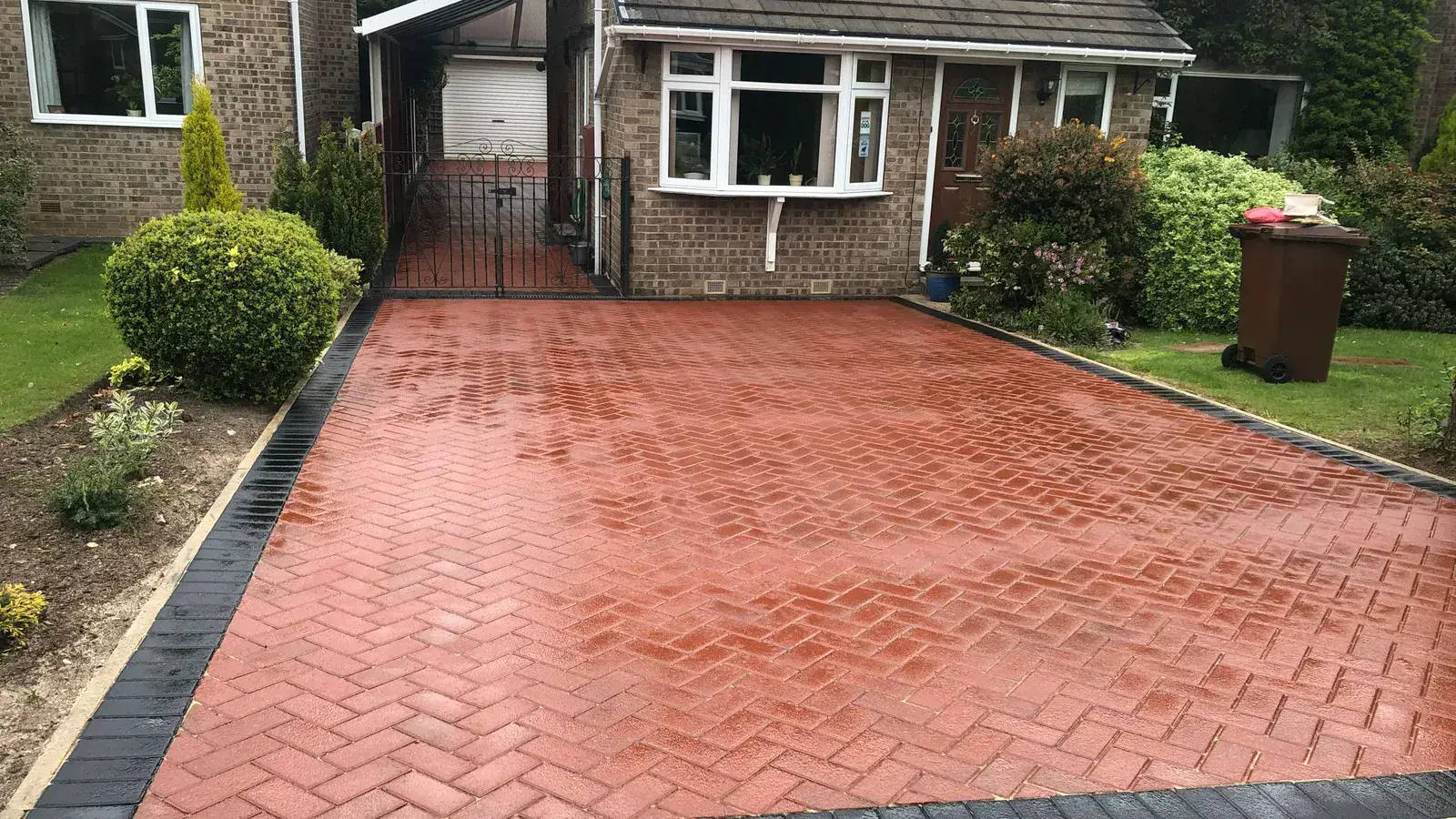
Block paving restoration in Leeds
Cleaning, re-sanding and sealing for block paved driveways, paths and patios right across the LS postcodes.
Get a free Leeds quoteBlock paving is the most common driveway surface in Leeds by a distance. Whole streets of it went down through the eighties, nineties and two-thousands across Crossgates, Rothwell, Garforth and the estates ringing the city, and most of it is still perfectly serviceable. What it is not is maintenance-free — and the maintenance it needs is almost always the same thing.
Nearly every problem starts in the joints
Block paving works by interlock. Each block is held in place by kiln-dried sand packed into the joints around it, and that sand is doing a structural job, not a cosmetic one. Almost every complaint we get in Leeds — weeds, moss, rocking blocks, spreading edges, a drive that has gone wavy — traces back to joint sand that is either contaminated or gone entirely.
Weeds are the clearest example. They are not growing up through the drive from below; a correctly built drive has a membrane and a compacted sub-base that prevents that. They are germinating in windblown soil and rotted leaf matter that has worked its way into the joints and turned clean sand into a thin strip of compost.
Why jet washing alone makes it worse
This is the single most useful thing we can tell a Leeds homeowner. Pressure washing a block drive without re-sanding it afterwards blasts the joint sand out along with the weeds. An empty joint then refills with dirt far faster than it ever held sand, so the following spring is heavier than the last. Do it a few years running and the blocks lose their restraint, start to rock, and eventually the edges begin to spread.
We see the end result of that cycle constantly — drives that have been washed religiously every year and are in worse condition than the ones next door that were left alone.
What Leeds weather adds to the problem
The Aire valley is damp and much of Leeds is well treed, particularly through Roundhay, Adel and Headingley. That means steady leaf fall into the joints each autumn and long wet spells that keep the surface damp enough for moss to establish. North-facing drives and the shaded strip along a boundary wall are always the worst affected, and on a sloping drive the lower half goes first.
How we put it right across the LS postcodes
The sequence matters more than any single product. We clean the surface and the joints properly, treat the moss and algae so it does not grow straight back, make good any sunken or rocking areas, then refill the joints — kiln-dried sand as standard, or a polymeric compound where a drive has been fighting weeds for years and you want it to stop.
Sealing afterwards is optional and we will give you a straight answer on whether it is worth it for your drive. On a sound, freshly re-sanded surface it stabilises the joints and lifts the colour, which is worthwhile. On a drive with a base problem it is money spent in the wrong order, and we will say so. Assessments across Leeds are free and carry no obligation.
Common questions
- Which parts of Leeds do you cover?
- The full LS postcode area — Roundhay, Moortown, Horsforth, Headingley, Garforth, Morley, Pudsey, Wetherby and the surrounding villages.
- Why do the weeds keep coming back on my Leeds drive?
- Because the joint sand has been contaminated with dirt and is acting as a seed bed. Until the joints are cleaned out and refilled, the weeds return every spring.
- Do you re-sand as well as clean?
- Always. Cleaning without re-sanding strips the joints and leaves the blocks unrestrained, which causes movement. The re-sand is the part that actually fixes the problem.
Restore your Leeds block paving
Book a free, no-obligation assessment and we will tell you honestly what your driveway needs.
Request your free quote