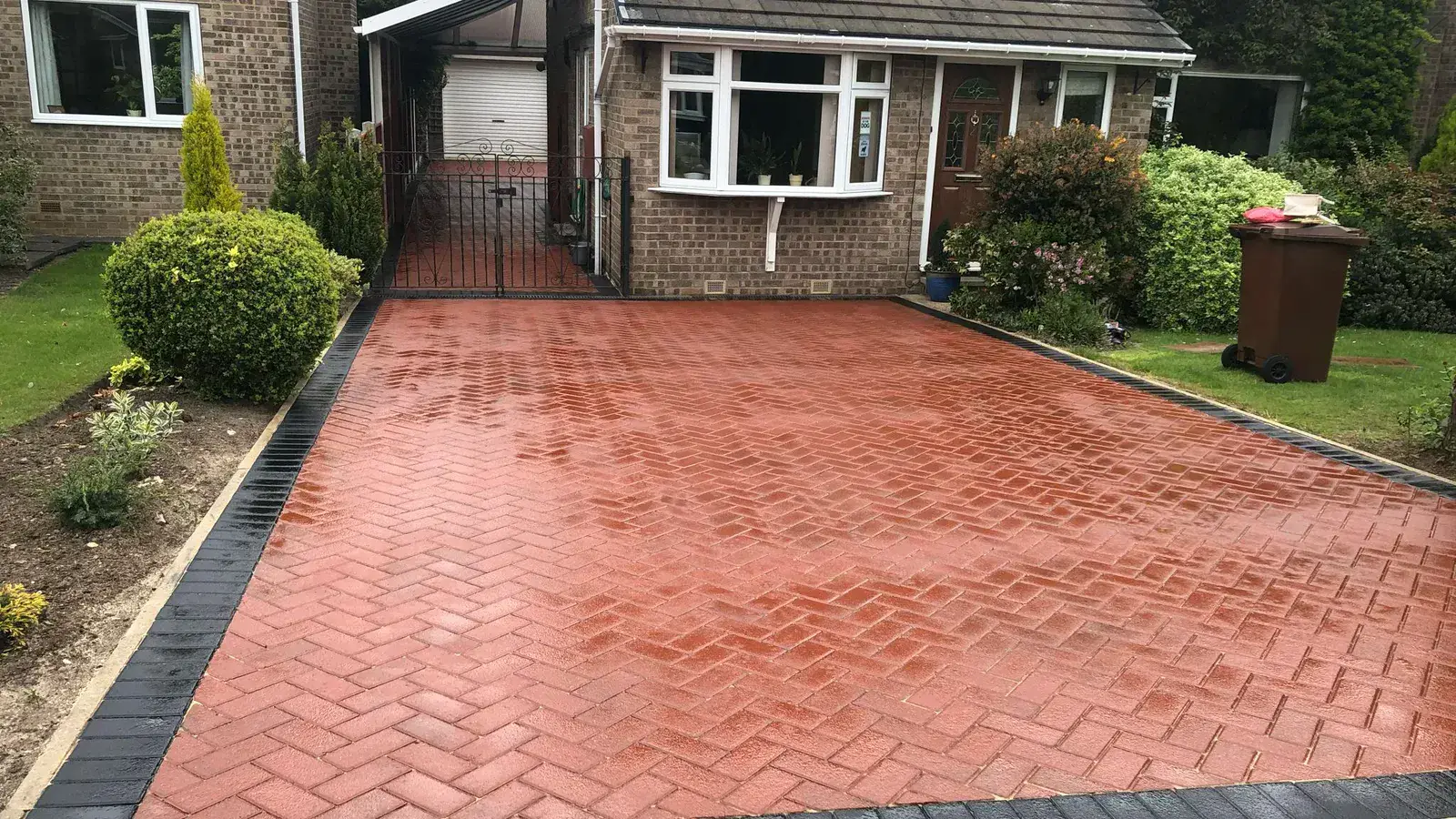
Block paving restoration in Pontefract
Cleaning, re-sanding and sealing for block paved driveways and patios across Pontefract and the villages around it.
Get a free Pontefract quotePontefract is one of the oldest towns in this part of West Yorkshire. The castle ruins still stand on their outcrop above the town, the market place is where it has always been, and the liquorice grown here gave the world Pontefract cakes. All of that history is in the middle of town, and none of it is block paving: the old streets are paved in stone and setts, and the houses stand close to the pavement. The drives we restore here belong to the rings of building that came afterwards.
Those rings are easy to read. Interwar semis and post-war estates sit just outside the historic core, with later private estates beyond them towards Carleton and along the roads out to Castleford and Knottingley. Block paving arrived late in the twentieth century, so what is here went down on the newer estates, or replaced a worn-out tarmac or concrete drive on the older ones.
Drives that are now well over twenty years old
A block drive laid in the 1990s is by now an old surface. By that age the sand swept in on the day it was laid has usually gone, and what sits in the joints is whatever has washed or blown in since: grit, leaf litter, wind-blown soil. That is a growing medium, and it is why moss and weeds appear in lines along the joints while the blocks themselves still look sound.
In Pontefract that pattern is common enough that we treat it as the default condition of a drive from that period, not a sign that anything was badly laid. The blocks have done their job. It is the filling between them that has run out.
Where new block meets old stone
A lot of Pontefract drives finish against something older than they are: a stone boundary wall, a stone kerb, a flagged path that was already there. Those junctions are where block paving most often fails. The whole field of blocks depends on a firm edge to stop it spreading under the weight of a car, and where the edge was set loosely against old stone it will have moved. Sand drains out along the line of the movement and a strip of blocks starts to sink.
Putting that right is not a clean-and-sand job. We lift the affected strip, re-bed and relay it against a firm edge, and only then refill the joints. Cleaned and re-sanded without relaying, a drive in that state looks right for a season and settles again.
A town built on a rise
The centre of Pontefract stands on a rise, with the castle on its outcrop and the ground falling away on several sides. On the estates around it many frontages slope towards the road, and rain runs off a block drive quickly, carrying loose sand from the upper joints. The usual result is a drive that is bare at the top and silted and mossy at the bottom, where the water finally slows down.
Before we choose between kiln-dried sand and a polymeric compound we look at which way the water goes, because on a slope that decision matters a good deal.
Carleton, Tanshelf and out to Darrington
Carleton, Tanshelf, Monkhill and Chequerfield are all parts of the town itself, with a spread of housing from interwar to modern. Darrington and Ferrybridge are separate villages on its edge, with older cottages and infill that can mean small plots and drives only one car long.
Short drives are quick to restore, but they take a disproportionate share of the wear, because every journey crosses the same few metres of block. If one strip has begun to sink, the rest of the surface usually follows within a few seasons.
Common questions
- Which parts of Pontefract do you cover?
- The WF8 postcode and the villages beside it: Carleton, Tanshelf, Monkhill and Chequerfield in the town, and Darrington and Ferrybridge on its edge. If you are unsure whether your road falls inside the area, ask and we will tell you straight.
- My drive finishes against an old stone wall and one edge is sinking. Is that a re-sand?
- Not on its own. A sinking edge means the blocks have moved, so they need to be lifted and relaid against a firm restraint before the joints are refilled. We will tell you at the assessment which of the two it is.
- I live in a conservation area. Does that affect restoring a block drive?
- Cleaning and re-sanding maintain the surface you already have and do not change how it looks. If you are thinking of changing the material or the layout, check with Wakefield Council first, as the town has conservation areas.
Also nearby
- Castleford — the next town to the north-west, with its own river-valley conditions.
- Wakefield — the city a few miles to the west.
- Leeds — to the north-west, beyond Castleford.
Read before you book
Two guides that apply to most Pontefract drives.
What we offer in Pontefract
Block Paving Cleaning & Restoration
Controlled pressure washing removes dirt, algae, moss and weeds — safely restoring tired block paving.
Pontefract block paving cleaning & restorationBlock Paving Re-Sanding
Fresh kiln-dried sand locks the blocks back together, stabilising the surface and helping to suppress weeds.
Pontefract block paving re-sandingBlock Paving Sealing
A protective seal enhances colour and guards against staining, weed growth and water damage.
Pontefract block paving sealingBlock Paving Recolouring
Restore faded, worn block paving to a rich, even colour using SmartSeal Block Magic.
Pontefract block paving recolouringRestore your Pontefract block paving
Book a free, no-obligation assessment and we will tell you honestly what your driveway needs.
Request your free quote