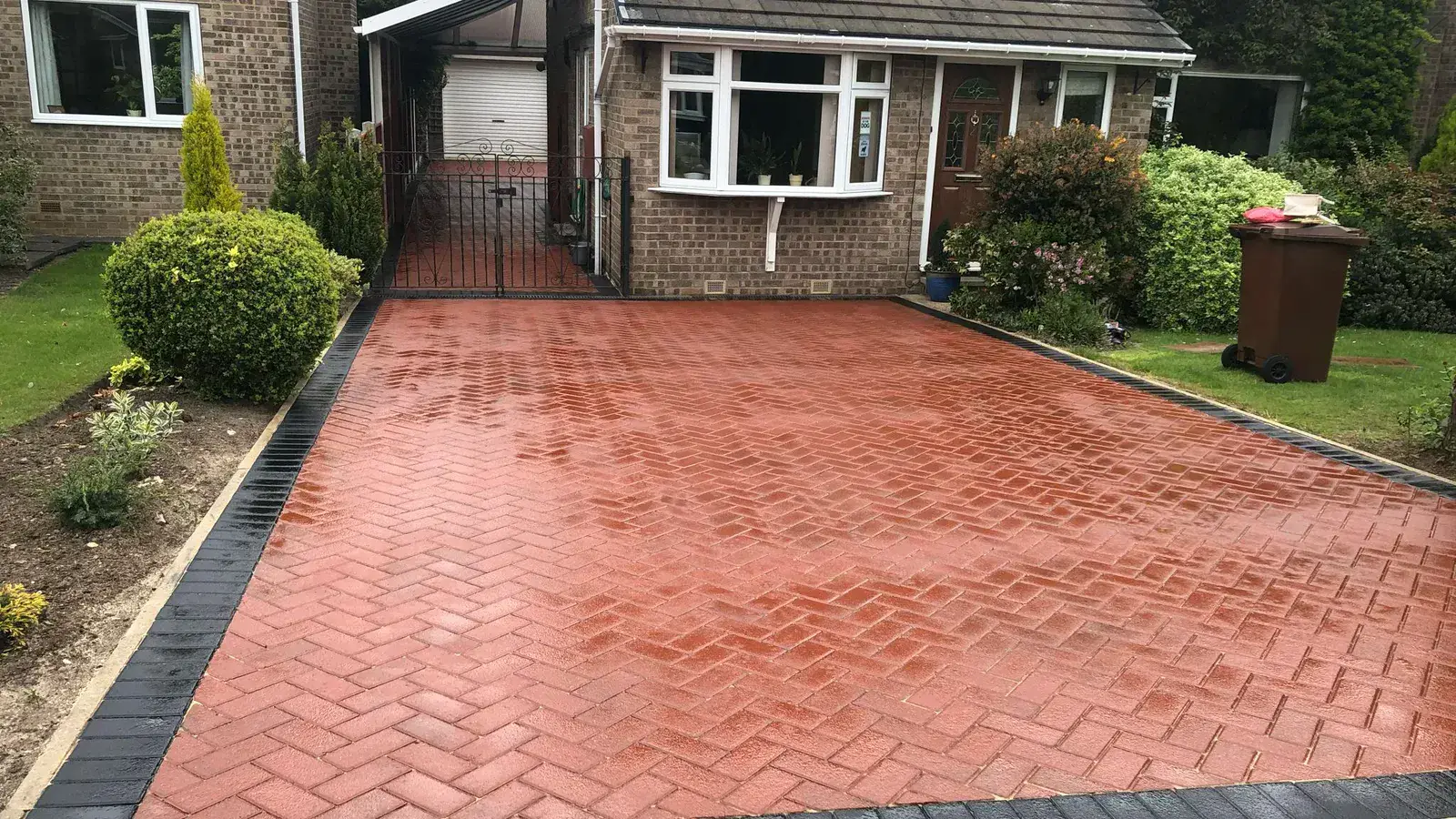
Block paving restoration in Castleford
Cleaning, re-sanding and sealing for block paved driveways and patios across Castleford and the villages around it.
Get a free Castleford quoteCastleford sits where the River Calder runs into the River Aire, and the town has always had to live with water. The low ground beside the rivers has flooded in the past, most memorably over Christmas 2015, and a drive laid on that sort of ground has a harder life than one on a hillside. It is worth saying at the start because it changes what we look for: here the question is less how fast water leaves a drive than what it leaves behind.
Away from the river the town is a mixture: terraces close to the centre, interwar and post-war estates running out through Airedale and Glasshoughton, and newer private building on the edges. Much of the block paving belongs to the later estates, where a drive and a pair of parking spaces at the front became the norm.
Silt, not just dirt
When water has stood on or over a paved surface it leaves a fine layer of silt, and silt packs into joints in a way ordinary grime does not. It is denser, it holds moisture, and it is a very good seedbed. A block drive that has had floodwater over it, or sits low enough to take run-off from the street, will often show a band of dark, compacted joints that a pressure wash alone will not clear.
The joint has to be opened out, the silt taken out to depth and fresh sand packed in. Skip that and the weeds are back by the following spring, usually thicker than before.
A drive that sits low in the street
Parts of Castleford are flat and low, and some frontages sit at or below the level of the road. Water arriving from the street is then running onto the drive, not off it. Where a drive has no fall away from the house, the water has nowhere to go but through the joints and into the bedding layer below.
Over years that washes out the fine material under the blocks, which is the reason for the shallow dips that collect puddles after rain. A dip is a signal that the bedding has lost material, and the answer is to lift and relay that patch rather than simply refill the joints on top.
Glasshoughton, Whitwood and the estates between
Glasshoughton grew up around its colliery, and the colliery site is now a retail and leisure area beside the motorway; the housing around it is mostly later estates. Whitwood, Airedale, Cutsyke and Smawthorne each have their own character, from older terraces near the river to the more open layouts of the later estates.
What they share is the age of the paving. Most block drives in Castleford went in from the 1980s onwards, which puts the majority of them at the stage where the original sand has gone and the joints have filled with whatever the weather brought.
Choosing the sand for wet ground
On low ground that stays wet we lean towards a polymeric compound for the joints, because ordinary kiln-dried sand is the first thing water carries away. A polymeric sets firm as it dries and resists wash-out. It is not magic: it needs the joints clean and dry when it goes in, and it will not hold if the bed below is still moving.
Where a drive is sound and well drained, plain kiln-dried sand is perfectly adequate, and we will say so. The choice follows the drive, not a preference.
Common questions
- Can you restore block paving that has been flooded?
- Yes, once the ground has dried out. Silt left by floodwater has to be removed from the joints to depth, not just washed off the surface, and any blocks that have moved are relaid before the joints are refilled.
- Which parts of Castleford do you cover?
- The WF10 postcode: the town centre, Airedale, Glasshoughton, Whitwood, Cutsyke and Smawthorne, and nearby villages such as Allerton Bywater.
- My drive holds a puddle after rain even though the blocks look fine. Is that a re-sand?
- A puddle on a block drive usually means the bedding beneath has lost some of its fine material and the surface has dipped. Refilling the joints alone will not lift it. That patch needs to be lifted, the bed topped up and the blocks relaid.
Also nearby
- Pontefract — just to the south-east.
- Wakefield — the city a few miles west.
- Leeds — up the Aire valley to the north-west.
Read before you book
Two guides that matter most on wet, low-lying ground.
What we offer in Castleford
Block Paving Cleaning & Restoration
Controlled pressure washing removes dirt, algae, moss and weeds — safely restoring tired block paving.
Castleford block paving cleaning & restorationBlock Paving Re-Sanding
Fresh kiln-dried sand locks the blocks back together, stabilising the surface and helping to suppress weeds.
Castleford block paving re-sandingBlock Paving Sealing
A protective seal enhances colour and guards against staining, weed growth and water damage.
Castleford block paving sealingBlock Paving Recolouring
Restore faded, worn block paving to a rich, even colour using SmartSeal Block Magic.
Castleford block paving recolouringRestore your Castleford block paving
Book a free, no-obligation assessment and we will tell you honestly what your driveway needs.
Request your free quote