Can block paving be recoloured?
6 min read Block Paving Revive
Blocks fade because the surface weathers, not because the colour washes out. Recolouring puts pigment back into that surface — here is what it can and cannot do.
Most block paved drives do not fail. They fade. The terracotta and buff that looked warm when they were laid flattens into a uniform grey, and the drive starts to look tired long before anything is structurally wrong with it.
The good news is that the colour has not washed away. It is still in the blocks. What has changed is the surface.
Why blocks lose their colour
Concrete blocks are pigmented through a facing layer only a few millimetres deep. Two things work on that layer. Ultraviolet light breaks down the pigment at the very surface, and rain, grit and tyres slowly abrade it. Add a film of algae holding moisture against the block and the colour reads flatter still.
There is a third culprit people mistake for fading. Efflorescence is a white bloom of lime salts drawn out of the concrete as it cures. It looks like the colour has gone patchy. It usually weathers off on its own within a couple of years and is not a fault.
Recolouring is not painting
This is the distinction that matters. Paint forms a film sitting on top of the block, and a film on a surface that gets driven on, frozen and soaked will eventually peel — usually in the wheel tracks first, which looks worse than the fading did.
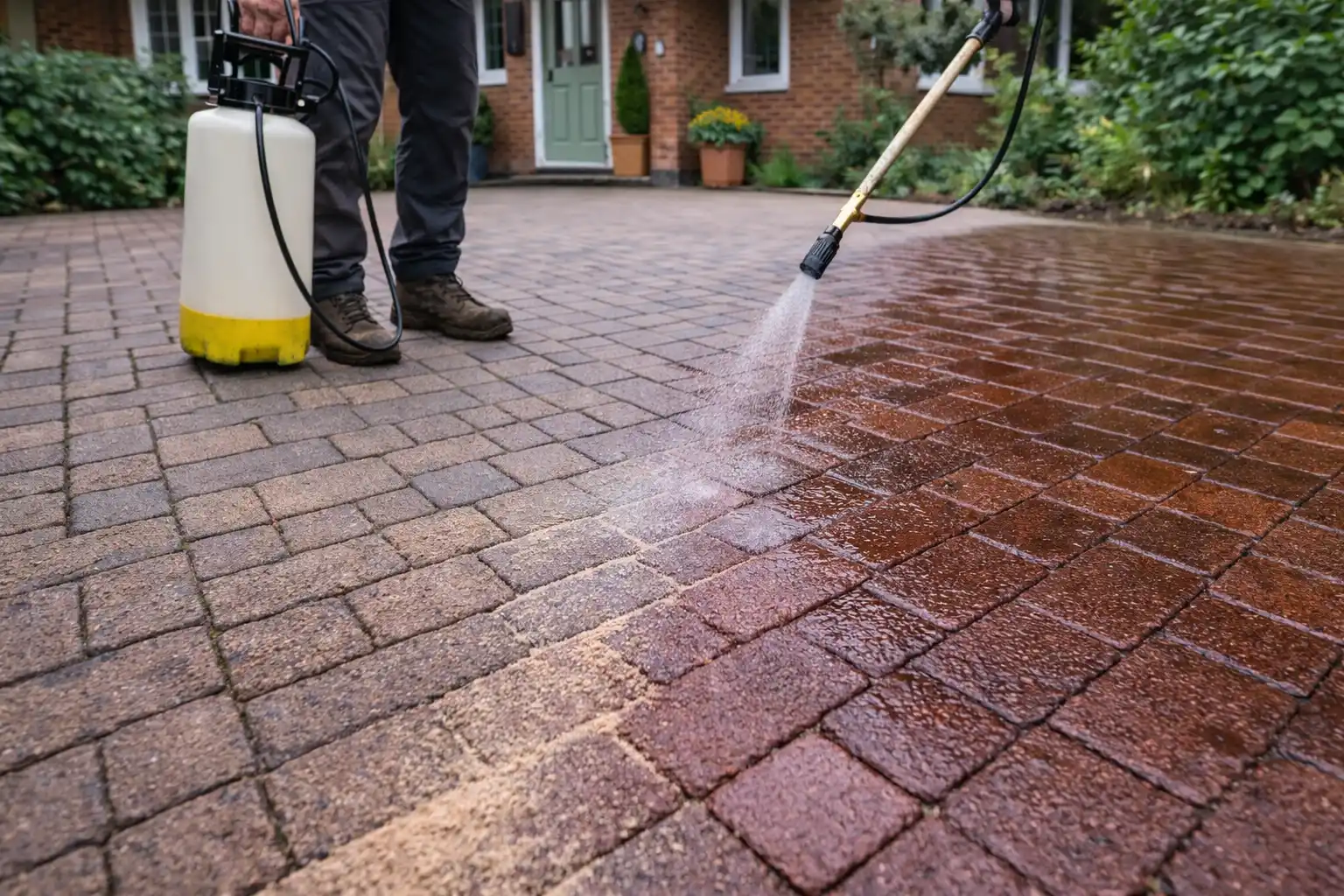
Recolouring uses a pigmented sealer that penetrates the weathered facing layer and cures within it. It restores the depth of colour rather than covering it, and as it wears it wears evenly instead of lifting at the edges.
Two levels of the same job
A tinted sealer
Where the blocks have dulled but the original colour is still visibly there, a lightly tinted seal is often enough. It deepens the tone, brings back a slight sheen and protects what is underneath. This is the cheaper end and suits a drive that has simply gone flat.
Full recolouring
Where the facing layer is genuinely spent — the blocks read grey regardless of how clean they are — recolouring puts pigment back in properly. It is the difference between reviving a colour and replacing one.
What has to happen first
Neither works on a dirty drive. The surface has to be given a professional clean and, on block paving, re-sanded, because pigment applied over contaminated joints and algae simply locks the problem in. Sealing damp paving is worse again: trapped moisture clouds the finish and can leave a permanent milky bloom.
What it will not fix
- Sunken or rocking blocks. That is a base problem. Colour on top of a dip is still a dip.
- Spalled or crumbling faces. If the surface of the block has broken up rather than worn, there is nothing sound for the pigment to key into.
- Oil staining. This needs treating before, not covering after.
- A completely different colour. Recolouring works with what is there.
Is it worth doing
Against the cost of lifting and relaying a drive, restoring the colour of one that is structurally sound is a fraction of the money and a day rather than a week. The honest test is whether the blocks are sound and only tired. If they are, recolouring will surprise you. If the base has moved, no amount of pigment is the answer, and we would rather say so at the quote than afterwards.
Common questions
- Is recolouring the same as painting the blocks?
- No. Paint sits on top and peels. A pigmented sealer soaks into the weathered surface layer and cures as part of it, which is why it wears rather than flakes.
- Can I change the colour of my drive completely?
- Not reliably. Recolouring restores and deepens the tone the blocks already have. Going from buff to charcoal is a replacement job, not a restoration one.
- How long does recolouring last?
- It depends on traffic and aspect. A drive parked on daily will show wear in the wheel tracks sooner than the edges. Expect to top up rather than never touch it again.