How to re-sand block paving properly
6 min read Block Paving Revive
Brushing sand across a drive is the easy part. Whether it stays in the joints depends on what was in them first, how dry everything was and how the sand was put in.
The sand between your blocks is not filler. A block paved drive holds together because the blocks are locked against each other through that sand, and the sand also stops the surface moving under a car. When it goes, the drive looks gappy first and starts to shift later. Putting it back sounds like a job for a stiff brush and a bag. It is, but the order and the conditions decide whether it lasts a season or several years.
Why the joints empty in the first place
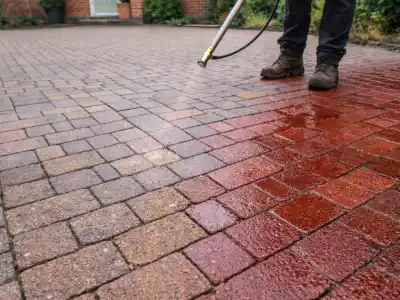
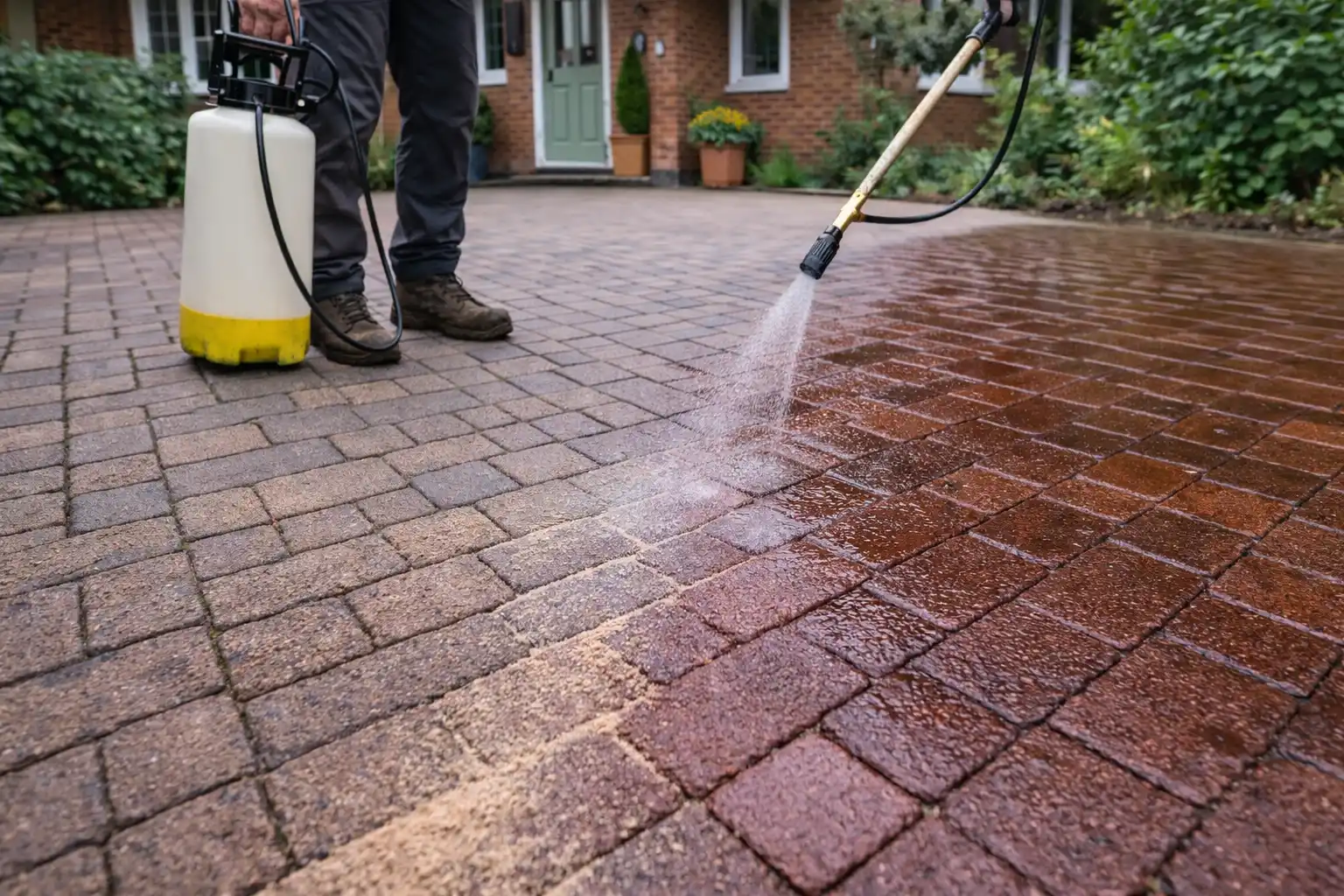
Jointing sand is lost gradually. Rain and surface water carry the fine grains out, brushing and tyres push it around, and ants and weeds displace it from below. A pressure wash accelerates all of it: a jet strong enough to lift algae will also blast sand out of the joints, which is why a drive that has just been cleaned always needs filling again. If the joints are empty after a wash, nothing has gone wrong. It is the next step that was missing.
Check what is in the joints before adding more
Fresh sand on top of old, contaminated sand does very little. The old material holds moisture, carries seed and breaks down into a fine silt, and new sand simply sits on that layer. The joints need to be properly cleaned out to a useful depth first. That is also why re-sanding belongs after a proper clean rather than instead of one.
The test is simple. Push a thin screwdriver or a stiff wire into a joint. If it goes in easily to the depth of the block, the joint is open and wants filling. If it meets compacted, dark, damp material a few millimetres down, that needs removing first.
The right sand
Use a dry, fine, washed kiln-dried sand sold for block paving joints. Builders' sand looks similar and is cheaper, but it carries clay and silt that hold water, so the joint stays damp and grows green and weeds again. Sharp, clean sand that flows freely is what you want. If it clumps in the bag, it is too wet to work with.
Kiln-dried sand is the usual choice for re-sanding. If the question is whether to use it at all or to go to a polymeric product, we set the trade-offs out in kiln-dried or polymeric sand.
Conditions matter more than technique
- The blocks and joints must be dry. Damp sand sticks to the surface and bridges across the top of the joint without ever reaching the bottom of it.
- Pick a dry spell. Heavy rain in the first day or two moves sand before it has settled.
- Do it after the clean has fully dried. Damp that is still in the joints from washing is the usual reason a re-sanded drive greens again quickly.
How it is put in
Spread the sand generously across the surface and sweep it in with a stiff broom, working in more than one direction, including diagonally across the joints. The aim is to push sand down into the joint rather than drag it along the top. Sweep the surplus off, then go over it again. The first pass settles the sand, and you will usually see the level drop.
On newly laid paving, a plate compactor with a rubber pad is run over the surface to vibrate sand down and lock the blocks. On an existing drive the same thing happens more slowly, through rain and traffic, which is why a top-up a few weeks later is part of doing it properly rather than a sign it failed.
How full is full
Fill the joints up to just below the edge of the block. Slightly under is correct. A joint filled flush gets tracked off on shoes and tyres within days, and a joint left half empty does not stabilise the block. Brush off every grain of surplus from the surface, because loose sand left on top is what gets walked into the house.
What it does and does not do
Re-sanding stabilises the blocks, restores interlock and takes away the open joint that weeds want. It does not fix a sunken drive, and it will not stop weeds arriving by windblown seed. We cover the base problems in why block paving sinks, and the growth side in why weeds keep coming back in block paving.
Sealing over fresh sand is the usual way to keep it in place on slopes and on drives that take a lot of surface water. If you would rather the work was done for you, our re-sanding service covers the clean, the drying time and the filling in the right order.
Common questions
- Why does the sand keep washing out of my block paving?
- Usually because the joints were wet or dirty when it went in, it was swept across the top rather than down into the joint, or the drive has surface water running across it. Sealing over the sand is the normal answer on a slope.
- Can I mix kiln-dried sand with cement for the joints?
- It can be done, but it is a different job. A sand and cement mix sets rigid. Block paving relies on flexible interlock, so a rigid joint cracks as the blocks move, it does not drain, and it cannot easily be redone. Kiln-dried sand is what the paving was designed around.
- Is there an alternative to kiln-dried sand for block paving?
- Polymeric jointing compound. It sets into a firm joint that resists weeds and washout, but it costs more and is unforgiving if it is installed in damp conditions or left on the surface.
- Can I re-sand block paving myself?
- Yes, if the joints are clean and the blocks are dry. A bag of kiln-dried sand and a stiff brush will do a small area. The part that is hard to do well at home is cleaning the old material out of the joints first.