Why block paving sinks, dips and lifts — and what each one means
7 min read Block Paving Revive
A dip near the garage, a rocking block, a bulge by the gate. Block paving moves for a handful of specific reasons, and telling them apart decides whether it is a morning job or a rebuild.
Block paving is a flexible surface. That is its great advantage over a slab — it can take ground movement without cracking. It also means it can move in ways concrete cannot, and the pattern of that movement tells you a lot about the cause.
Localised dips
A distinct hollow, often a metre or so across, usually where vehicles turn or park.
This is nearly always the laying course or sub-base consolidating under load, either because it was not compacted properly at installation or because water has washed fines out of it. If the dip is at a low point where water collects, that is a strong hint.
The fix: lift the affected blocks, correct and recompact the base, relay. The blocks themselves are almost always reusable. This is a contained repair, not a rebuild.
Rocking or loose individual blocks
A block that moves underfoot while its neighbours are solid.
This is a joint problem rather than a base problem. Block paving works by interlock: each block is held by the sand-filled joints around it. Empty the joints and blocks lose their restraint. It is very often a consequence of repeated pressure washing.
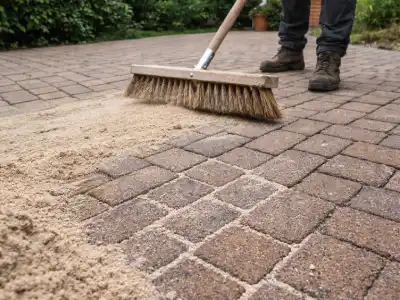
The fix: clean out and re-sand the joints across the drive, then compact. Cheap, quick, and it prevents the next stage.
Movement along the edges
Blocks spreading, splaying or dropping along the outer edge of the drive, often with widening joints running back from it.
This is edge restraint failure. The whole drive relies on a haunched edge course to hold everything in compression. Once that gives — usually because the haunching was skimped or has broken up — the field of blocks starts creeping outwards, and it does not stop on its own.
The fix: rebuild the edge restraint properly, then re-lay and re-sand the disturbed area. Worth doing promptly; the affected area grows every year it is left.
Rutting in the wheel tracks
Two parallel depressions following where vehicles drive.
Usually the sub-base is too shallow or too weak for the loading — a drive built for a car now taking a van, or one that was under-specified to begin with. Sometimes it is soft ground beneath.
The fix: this one is genuinely structural. The affected strips need excavating and rebuilding with an adequate sub-base. Relaying the blocks alone will simply rut again.
Bulges and heave
An area pushed upward rather than sunk.
Tree roots are the usual culprit, occasionally frost heave in badly drained ground, and sometimes a service trench that was backfilled poorly. Roots need dealing with at source or it recurs.
How urgent is it?
Roughly in order of how quickly it will cost you more by waiting:
- Edge restraint failure — spreads continuously. Deal with it.
- Dips holding water — the water accelerates the washout that caused them.
- Rutting — will worsen with every loaded vehicle.
- Loose blocks and empty joints — cheap now, and preventing the ones above.
- Minor settlement that is stable — can often wait for a general overhaul.
The encouraging part is that block paving is repairable in a way that few surfaces are. Blocks lift, bases are corrected, and the same blocks go back down. A drive that looks past saving is very often a base repair, a full re-sand and a seal away from looking right again.
Common questions
- Can sunken block paving be repaired without replacing it?
- Usually. The blocks are lifted, the base beneath is corrected and recompacted, and the same blocks are relaid. Full replacement is rarely necessary.
- Why are my blocks rocking underfoot?
- The joint sand has been lost, so the blocks have nothing holding them in interlock. Cleaning and re-sanding the joints resolves it.
- What causes block paving to spread at the edges?
- Failed edge restraint. The haunched edge course keeps the whole surface in compression, and once it breaks up the blocks creep outward progressively.