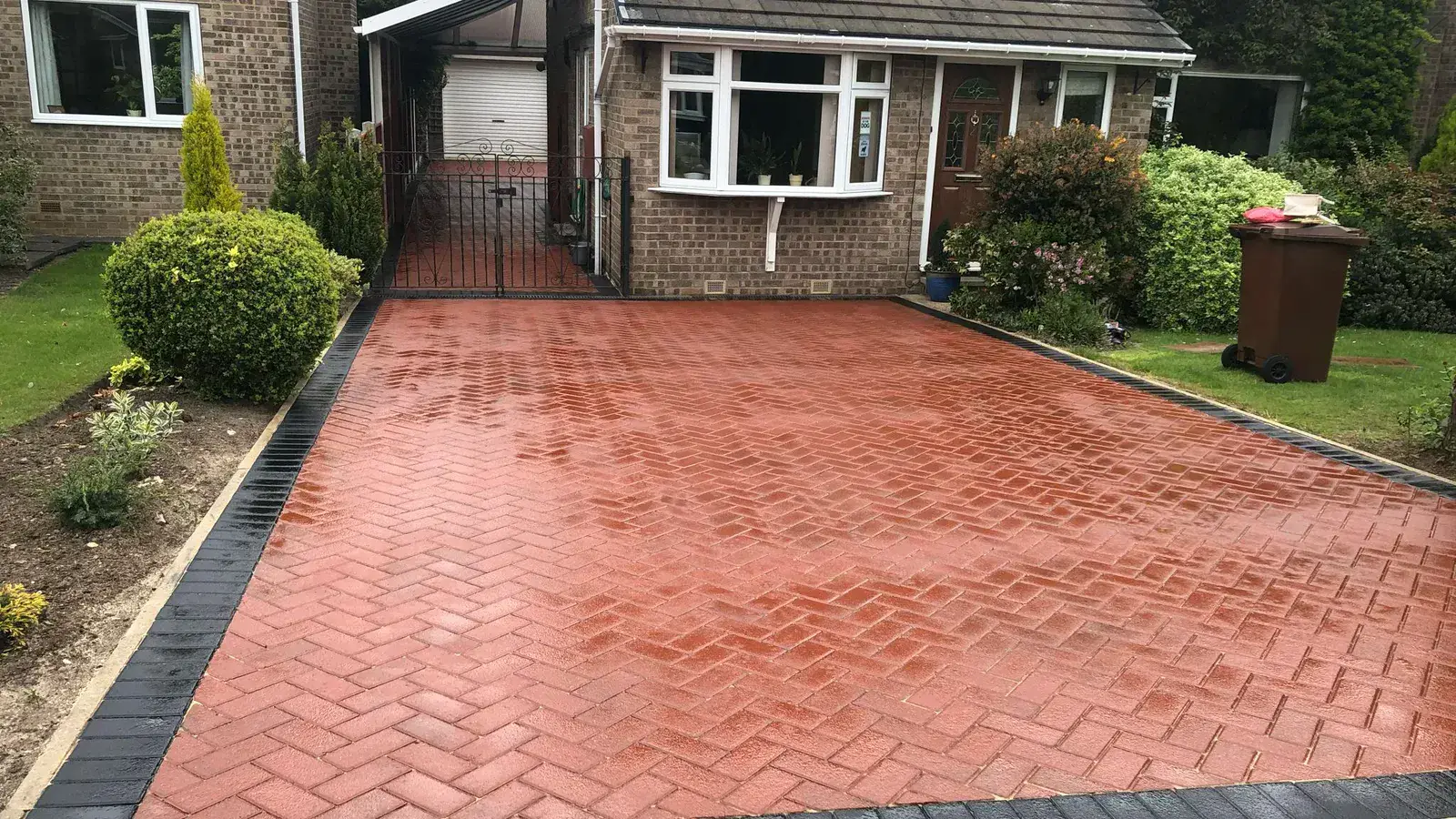
Block paving restoration in Halifax
Cleaning, re-sanding and sealing for block paved driveways and patios across Halifax and Calderdale.
Get a free Halifax quoteHalifax stands in a steep valley on the edge of the Pennines, and it is built in stone: the dark gritstone of the Calderdale hillsides, used for everything from the Piece Hall, the Georgian cloth hall in the centre of town, to the terraces that climb the valley sides. That stone and that setting make Halifax a very different place to work from the lowland towns further east.
The weather comes with the setting. Calderdale is among the wetter parts of West Yorkshire, and the valley sides mean that many frontages are shaded for much of the day in winter. For block paving the combination of damp, shade and stone is the main thing. Moss here is not an occasional visitor; it is the default.
Shade from the valley and from the walls
Many Halifax drives sit between high stone walls, or below a retaining wall holding up the garden above. Walls give privacy, but they cast shade and hold moisture, and they drop a steady trickle of grit and moss spore onto the surface below. On a drive like that the north side may never fully dry out between October and March.
The joints on the shaded side wear first, and they fill with fine, damp material that no amount of sweeping removes. Those joints need to be dug out and refilled, not just topped up.
Frost and the slip question
Wet algae on block paving is slippery, and on a steep Halifax drive that is more than a cosmetic issue. A thin green film on a gradient can be treacherous underfoot in winter, to a walker and to a car's tyres alike.
Washing it off gives a clean surface that is fine for a few months and slick again by the spring, because the spores and the damp conditions are still there. We treat the surface as well as washing it, which slows the return.
Sealing, moss and what a seal can and cannot do
On wet, shaded drives the question we are asked most is whether sealing will stop the moss. It will not. What a seal does is lock the sand in place and make the surface easier to keep clean, and a drive with firm, full joints is much less hospitable to moss than one with open joints.
So the order matters. Clean and treat first, refill the joints properly, and seal afterwards if it is worth it. On a heavily shaded drive we will sometimes say that a seal is not worth doing, and we would rather say so.
Savile Park, Skircoat Green and the villages
Skircoat Green and Savile Park have large Victorian and Edwardian houses; King Cross, Pellon and Boothtown sit on the hillsides closer in; Southowram and Shibden overlook the valley from the east. The housing is mixed and the drives are mixed with it.
Calderdale is large, and as you go further up the valleys the sites become more remote. For addresses on the far side of the district, ask first and we will tell you honestly whether it is within reach.
Common questions
- Which parts of Halifax do you cover?
- The HX postcodes around the town: Halifax itself, Skircoat Green, Savile Park, King Cross, Pellon, Boothtown, Southowram and Shibden. Further up the valleys towards Hebden Bridge and Todmorden, ask first.
- Will sealing stop moss coming back on my shaded drive?
- No sealer stops moss. What a seal does is lock the sand in, and a drive with firm, full joints is much less hospitable to moss than one with open joints. We would generally advise cleaning, treating and re-sanding first.
- Why does the green film come back within a few months of washing?
- Because washing removes the visible algae but leaves the spores and the damp, shaded conditions that produced it. Treating the surface as well as washing it slows the return.
Also nearby
- Bradford — to the north-east.
- Huddersfield — to the south-east.
- Dewsbury — to the east, down the valley.
Read before you book
Two guides for wet, shaded drives.
What we offer in Halifax
Block Paving Cleaning & Restoration
Controlled pressure washing removes dirt, algae, moss and weeds — safely restoring tired block paving.
Halifax block paving cleaning & restorationBlock Paving Re-Sanding
Fresh kiln-dried sand locks the blocks back together, stabilising the surface and helping to suppress weeds.
Halifax block paving re-sandingBlock Paving Sealing
A protective seal enhances colour and guards against staining, weed growth and water damage.
Halifax block paving sealingBlock Paving Recolouring
Restore faded, worn block paving to a rich, even colour using SmartSeal Block Magic.
Halifax block paving recolouringRestore your Halifax block paving
Book a free, no-obligation assessment and we will tell you honestly what your driveway needs.
Request your free quote