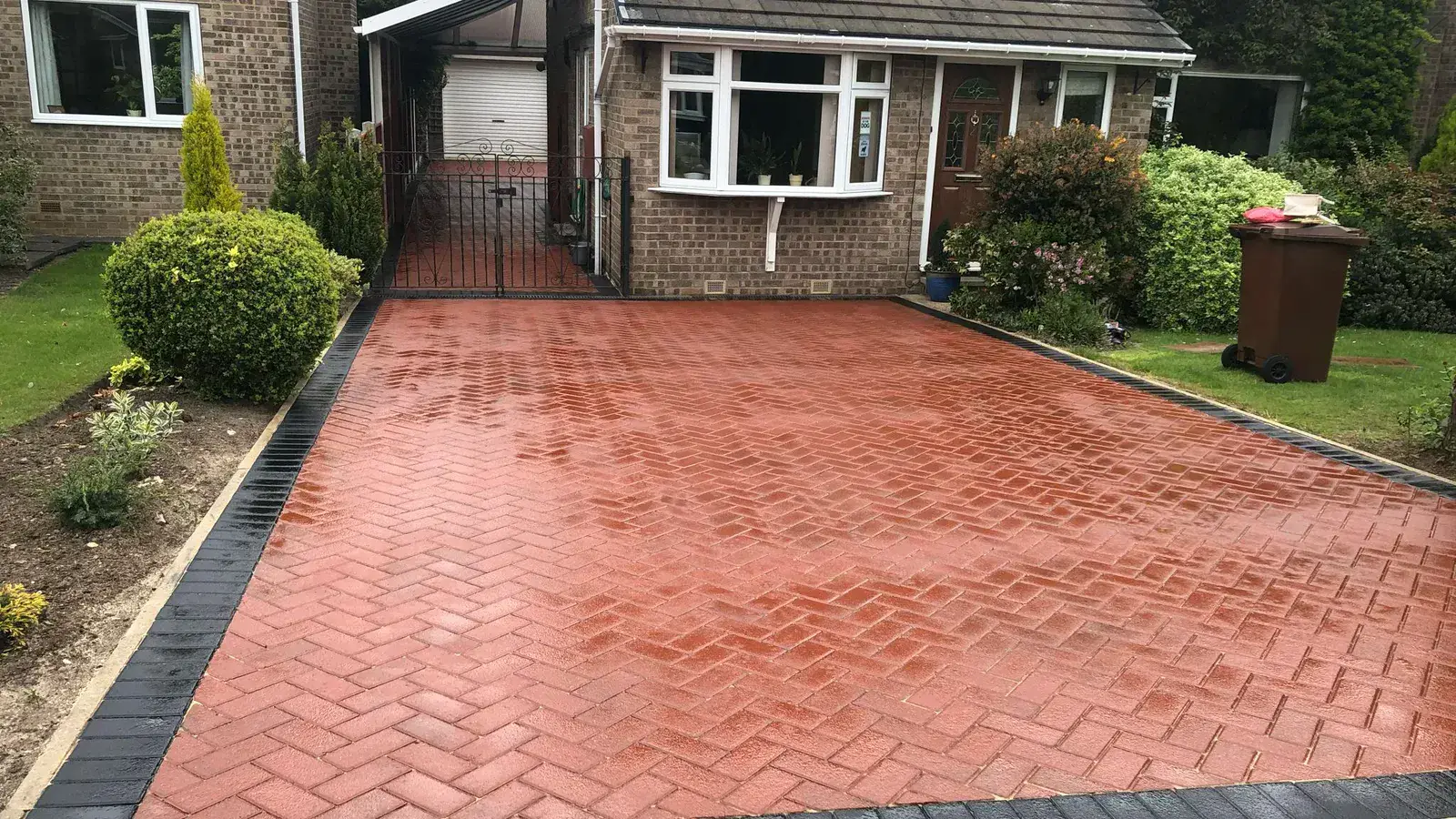
Block paving restoration in Huddersfield
Cleaning, re-sanding and sealing for block paved driveways and patios, from the valley floor to the Pennine villages above it.
Get a free Huddersfield quoteHuddersfield sits where the Colne and Holme valleys meet, and almost everything about it is a slope. Streets climb from the town centre towards Castle Hill, Almondbury and Lindley, and beyond them the ground rises on towards Marsden and the Holme Valley. That shape matters for block paving because water and sand both travel downhill, and a drive on a gradient ages unevenly in a way a flat one never does.
This page is about what the area does to block paving, and what puts it right. Most of the cleaning and restoration we are asked about here comes down to the same few problems: joints that have lost their sand, moss on the shaded side, and edges that have started to move.
Stone terraces below, block-paved drives above
The historic core is mill-town housing in local stone: terraces, back-to-backs and the grander villas on the hills. Those mostly have flagged yards or setts, not block drives. The block paving is on the later housing, in the estates that spread up the valley sides and in the newer closes tucked along the valley bottoms, most of it built in the decades since the war, when a driveway became something a house was sold on.
Many of these plots are cut into the hillside, with a drive that drops from the road to a garage or climbs from it to a front door. Sloped drives take a lot of rain across their surface rather than letting it soak in, which is exactly the condition that scours joint sand out.
Why sloped drives lose their sand
Block paving stays put because of the sand between the blocks. On a gradient, every heavy shower rinses a little of it down the joint line, and it collects at the foot of the slope or runs off into the drain. The upper blocks lose their support first and start to rock under tyres; the lower ones clog with silt and take on weeds.
That is why a surface here can look fine at the top and fail at the bottom. A proper re-sanding job tops up every joint, not only the obvious ones, and where a drive has been losing sand for years a polymeric compound holds better against running water than loose sand does. Our post on kiln-dried or polymeric sand explains the difference.
Damp, shade and a hard frost
The upland side of the borough is wetter and colder than the lowlands to the east, and the villages at the top of the valleys are more exposed again. Walls and hillsides throw long shadows across north-facing frontages in winter, so a drive can stay wet for days. Moss and algae thrive on exactly that, and the green film they leave is slippery as well as ugly.
Frost does a different kind of damage. Water in the joints and under the blocks freezes, expands and shifts things by a fraction each winter. Over many winters that can lift edges and open up gaps. It is another reason empty joints are worth fixing before they become a repair.
If weeds are your main complaint, our guide to why weeds keep coming back in block paving shows where they root. If the surface itself has dipped, read why block paving sinks and lifts before assuming it needs relaying.
What the work involves in practice
We clean the blocks and the joints, treat the moss and algae, and fix any area that has sunk before refilling. The last step, sealing, is optional and we will say plainly whether your drive needs it. If the colour has faded unevenly, recolouring is possible, though our post on whether block paving can be recoloured sets out its limits honestly. For rough budgeting ideas see what block paving cleaning costs.
Neighbouring areas have their own conditions: the damp Pennine-edge conditions around Wakefield are covered on our Wakefield page, and the high ground around Penistone is described on our Barnsley page. The wider picture is on our Yorkshire overview. Assessments are free and carry no obligation.
Common questions
- Which parts of the Huddersfield area do you cover?
- The HD postcodes around the town, including Lindley, Almondbury, Golcar, Marsden, Meltham and Holmfirth. If you are on the edge of those and not sure, the coverage map on our contact page shows how far we travel.
- My drive is on a slope. Does that change how it is repaired?
- Yes. On a gradient the joint sand migrates downhill, so the lowest courses are usually the emptiest and the top of the drive may be fine. We refill the whole surface, but pay particular attention to the lower end and to any edge restraint that has started to creep.
- Why does my block paving go green so quickly up here?
- Height and shade. Ground in the upper valleys stays wet for longer after rain and gets less low winter sun, and moss and algae need nothing more than prolonged damp. A treatment after cleaning slows it down, but it will not stop it for good.
- Should I seal a drive that ices over in winter?
- It is worth thinking through. Sealing locks the joint sand and makes the surface easier to keep clean, but a sealed surface can be slicker in frost. Our blog post on whether sealing is worth it covers the trade-offs, and we will give you a straight answer on site.
What we offer in Huddersfield
Block Paving Cleaning & Restoration
Controlled pressure washing removes dirt, algae, moss and weeds — safely restoring tired block paving.
Huddersfield block paving cleaning & restorationBlock Paving Re-Sanding
Fresh kiln-dried sand locks the blocks back together, stabilising the surface and helping to suppress weeds.
Huddersfield block paving re-sandingBlock Paving Sealing
A protective seal enhances colour and guards against staining, weed growth and water damage.
Huddersfield block paving sealingBlock Paving Recolouring
Restore faded, worn block paving to a rich, even colour using SmartSeal Block Magic.
Huddersfield block paving recolouringRestore your Huddersfield block paving
Book a free, no-obligation assessment and we will tell you honestly what your driveway needs.
Request your free quote