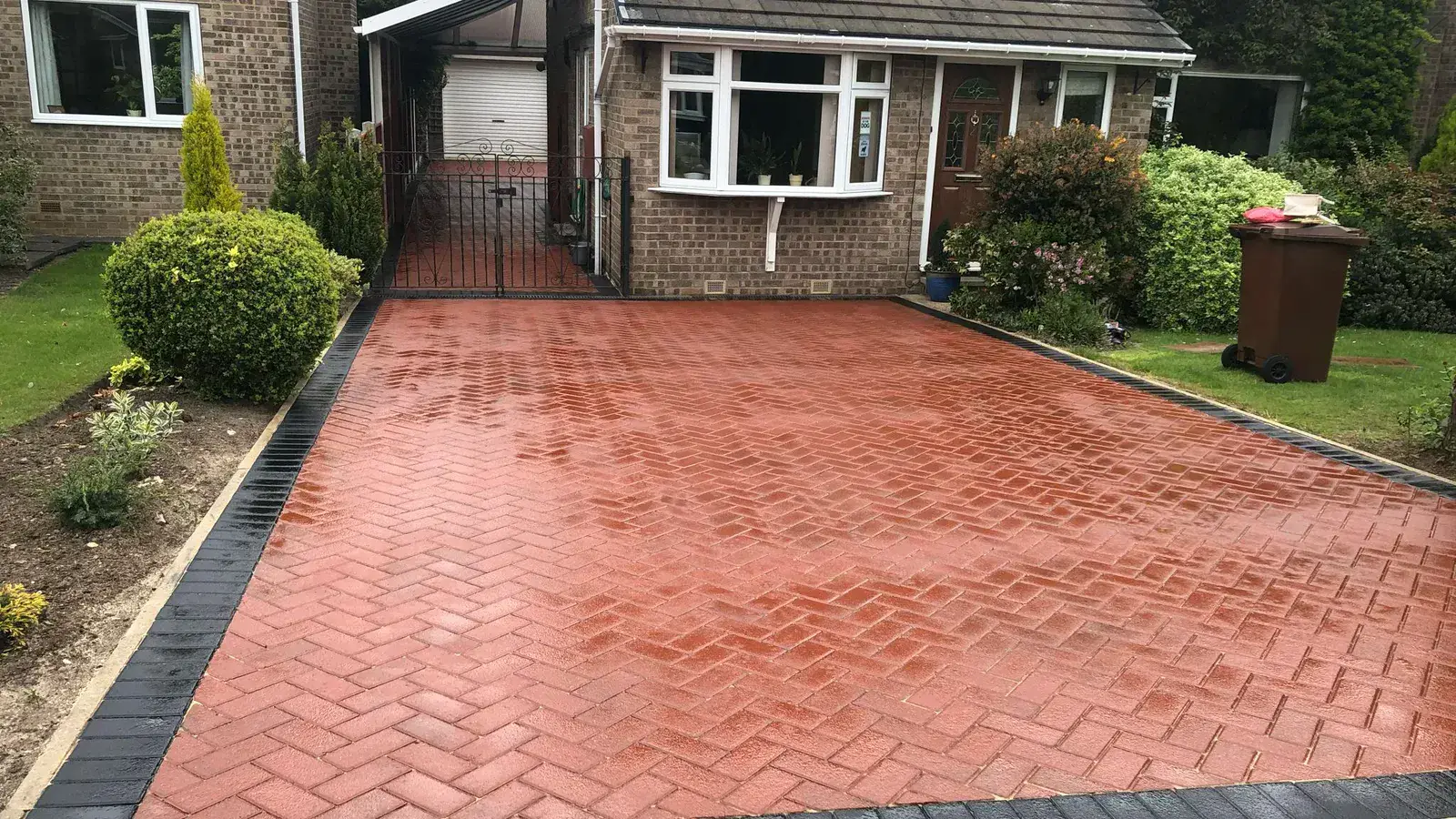
Block paving across Yorkshire
How the county's hills, rainfall and ground change what happens to a block paved drive, and what to do about it.
Get a free quoteYorkshire is a big county with very little in common between its two ends. The Pennines run down its western side, the Dales and the North York Moors fill the north, the low flat Vale of York sits in the middle, and the land falls away east over the Wolds to the Humber and the coast. A block paved drive laid in Hebden Bridge and one laid in Beverley are the same product, but they are not living the same life.
This page is about how those differences play out, so that you can recognise what is happening on your own drive. Where we work is a separate matter and is set out in the FAQ below. Whichever part of the county you are in, the repair follows the same logic: cleaning, re-sanding and, if it is justified, sealing.
The west is wetter, the east is drier
Weather in Yorkshire comes in from the Atlantic, and the Pennines catch most of its rain before it reaches the east. That is why the west of the county is markedly wetter than the plain beyond it. In the hill towns, surfaces stay damp for long periods, and damp is all moss and algae need. Drives there green over quickly and stay slippery through the cooler months.
Further east, rain is lighter and the sky brighter. Block paving there tends to suffer less from organic growth and more from sun fade, dust and weed seeds blown across open farmland. The joints still empty over the years, but the drive is not forever wet.
Stone, brick and what lies beneath
The ground under a drive is as important as the blocks on top. In the Pennine valleys, steep plots are cut into the hillside, so water runs across the surface and takes sand with it. On the clay soils of the lowland vales, the base can swell in a wet winter and shrink in a dry summer, which shows up as sinking or lifting. Why block paving sinks and lifts goes through each symptom.
Housing varies with the ground. Millstone grit and sandstone houses dominate the hills, magnesian limestone runs in a belt through the middle of the county, and brick takes over across the plain. Each era has its drives: 1970s and 1980s estates, later infill, and new-build closes where the original sand has never been topped up.
What goes wrong everywhere, and why
Three problems appear in every part of the county. Joint sand wears out, which lets weeds in and the blocks move. Moss, algae and leaf staining build up wherever the surface stays shaded. And a blast with the pressure washer, on its own, makes things worse by removing what sand is left. Our posts on why weeds return in block paving and how often block paving should be cleaned set out each of these in plain terms.
Sand choice matters as much as sand quantity. Where drives are on a slope or fight constant weed growth, polymeric sand holds better; on a quiet flat drive, kiln-dried is usually enough. Our comparison of kiln-dried and polymeric sand explains when to use which, and whether sealing is worth it helps decide the last step. If the colour has faded unevenly, recolouring is covered on its service page and in our recolouring post.
Where we actually work
We are based in Wakefield and our town pages go into local detail: Wakefield, Leeds, Huddersfield, Barnsley and Sheffield. Our full list of areas is the quickest way to find yours. Budget guidance is in what block paving cleaning costs, and assessments are free.
Common questions
- Which parts of Yorkshire do you cover?
- We are based in Wakefield and cover West Yorkshire and the surrounding areas. The map on our contact page shows how far we travel. All quotes are free and no-obligation.
- Does block paving age differently in different parts of the county?
- Yes, mainly through rainfall, shade and ground. The wet western side grows moss and algae faster; heavy clay ground can let a base move; and tree-lined suburbs add leaf staining wherever they are.
- Is there one treatment that suits every drive?
- No. A drive with healthy blocks and empty joints needs re-sanding, a stained one needs cleaning first, and a faded one may suit recolouring. Which it is depends on the surface in front of us, not the postcode.
- Where should I start if I am not sure what my drive needs?
- With a free assessment. We look at the blocks, the joints and the base and tell you honestly which of the four services, if any, makes sense.
What we offer in Yorkshire
Block Paving Cleaning & Restoration
Controlled pressure washing removes dirt, algae, moss and weeds — safely restoring tired block paving.
Yorkshire block paving cleaning & restorationBlock Paving Re-Sanding
Fresh kiln-dried sand locks the blocks back together, stabilising the surface and helping to suppress weeds.
Yorkshire block paving re-sandingBlock Paving Sealing
A protective seal enhances colour and guards against staining, weed growth and water damage.
Yorkshire block paving sealingBlock Paving Recolouring
Restore faded, worn block paving to a rich, even colour using SmartSeal Block Magic.
Yorkshire block paving recolouringRestore your block paving
Book a free, no-obligation assessment and we will tell you honestly what your driveway needs.
Request your free quote